Saturday, May 21, 2016

THE MODERN VEGETABLE

Juiced up, fluffed out, carbon choked, water logged, toxin bloated, tasteless, useless, unhealthy biomass 

Very fat people are very unhealthy. There is no such thing as a fit fat person. They are filled to the brim and beyond with blubber and water. Unless they have some other physical ailment which they cannot control, the only reason why they’ve blown themselves up like balloons is because they ingest excessively, the resources of this planet for no earthly purpose that can be reasonably justified even to themselves. Whether a person oversized to five or six times their healthy BMI will look good or bad is not something I am going to go into because beauty is in the eyes of the viewer.

Now, while a pretty large majority of people would probably agree with me on the health issues of obesity and might pity a fat person on the one side and roundly condemn the person on the other, they will embrace another fat entity with alacrity although that entity is fat for very similar reason.

I am talking about the modern vegetable.

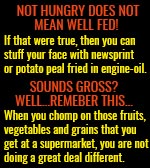
Look at that thing that you love so much: huge, fat, shiny, tasteless and filled with what? Nutrients? Nah. Minerals? Nah. Then what? Well, just biomass mostly. Carbon based materials that do zilch for our health and wellbeing. They have become so bloated because they are created by trick and truck to enhance their size and appearance and fed by a cocktail of killer toxins to keep them alive since their ability to keep themselves alive naturally has been compromised by the very unnaturalness of their design, birth and existence.

We…? LOVE ‘EM! Despite the fact that doctors and others are promoting us to "be just the size that will make us win", despite the fact that we are very clear over-sized is under-healthy, we seem to have been mass hypnotized into ignoring this simple, straightforward truth. Why? Because we are nuts, let me tell you.

OK … enough giggles and politically incorrect comparisons and anecdotes. Let’s get down to the science of this thing and the meanness with which something that is very bad for us has been coaxed into our subconscious selves as something that is good for us, great for us and looked for by default over everything else. 

Good people, the so-called agro-scientists of this world (read: the yay-sayers of the food and agrochemical mafia) insist that we must must must cultivate crops that have an optimal yield. They repeat this like a mantra, to everyone who cares to listen and force it down the throats of those who don’t through power, pressure and barrel loads of money and political clout. What they are saying to us essentially is simply this: we need more and more and more biomass to feed the world so that it is not hungry. Excuse me? Seriously? By that argument, there should be little to choose between eating a tasteless, nutrient less, water logged and bloated karavila and a ream of A4 sheets for all the good either of them will do you because both of them have very little food value. The former is marginally more palatable than chomping on A4 sheets … marginally. Try it. I’ve done it. I really cannot taste much of a difference between a steamed new-look, new-age, obese karavila and a piece of paper. 

So, folks, why do these scientists lie to us? That’s stupidly easy. To grow more biomass we need to grow the hybrids and to grow those we have to bumkiss the seed mafia and the agrochemical mafia and toe every line they put in front of our feet in terms of … he he … MONEY. We also have to use up a huge amount of energy to cultivate them that we really cannot afford these days. You and I (dumb ignoramuses by choice) grin, gleam, and run to a supermarket for … what do we call them…? Ah yes… “fresh vegetables” - regardless of the fact that they have very little vegetable in them and are far from fresh.  We also contribute substantially to poisoning our earth, cannibalizing critical energy resources and feeding the medical industry with a generally sick body they can profit out of. What do we call people like us? That’s easily answered as well. Losers folks, losers.

The point I am trying to make, and which I will promote as strongly as the mantra of the agrotoxin based yield optimization gurus is this: It is not yield density(YD) that is important you coots, its nutrient density (ND) where ND is defined as the amount of nutrients in a food relative to calories . What vegetables have high nutrient density? Indeed, what type of produce can reasonably be called vegetables since they have everything that defines them as such and have nothing that doesn’t? The very ones that you thumb your nose at because they don’t shine enough, they are not fat enough, they don’t look clean enough – plus – ugh – some of them have … (horrified whisper) worms in them.

I am talking about naturally grown heirloom or indigenous varieties. Unit for unit, eating 1/10th of a genuine, nondescript of an heirloom variety will give you 10 times the food value of eating the equivalent, toxin-manufactured, genetically engineered, hybridized bloat that you call “food”. You eat that heirloom variety and you also substantially reduce the sum total of resource usage in the world because you don’t need to eat as much to feed yourself.

 The science is clear. It has been clear from the 1940s when scientists first began making foreboding observations of the rapid dilution of minerals in the environment. Many studies over the last 70 years have not only strengthened this understanding of the rapid and irreparable damage to the soil but point squarely at agrochemicals and overfarming for yield optimization as the chief culprit. The issue is exacerbated by the food mafia trying to give us bigger, cleaner looking food on the outside but which is dirty, disgusting and useless on the inside while either preventing actual foods from getting to the people or undermining their desire for real foods through their marketing techniques. What we have ended up with is far far less karavila in karavila plus a load of gunk that is not only useless but downright dangerous for us.

More recently, in 2004, Dr. Donald Davis of the University of Texas and his fellow researchers Drs. Melvin Epp and Hugh Riordan of the Bio-Communications Research Institute in Wichita, Kansas have proved a rapid drop off of mineral content in 43 garden crops. These were the literally “mission critical” nutrients protein, calcium, phosphorus, iron, riboflavin and ascorbic acid. They site three factors, a) An inverse relationships between crop yield and mineral concentrations—the widely cited “dilution effect”; 2) Apparent median declines of 5% to 40% or more in some minerals, vitamins and proteins in groups of vegetables and perhaps fruits; and 3) Recent side-by-side plantings of low- and high-yield cultivars of broccoli and grains found consistently negative correlations between yield and concentrations of minerals and protein, a newly recognized genetic dilution effect.

So folks, bigger vegetables - like bigger people, aint better. Bigger vegetables do not feed a body’s needs but rather, feeds the addiction of a body to consume sweet nothings in excess. You will need five hybrid carrots to give you the same food you get from one heirloom carrot. You will need 20 servings of fruit and vegetables a day instead of the usual 5.

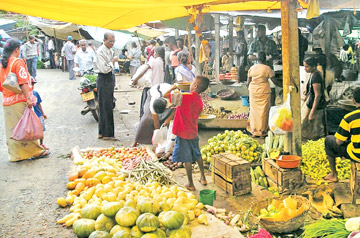
So folks, next time, when you want to give yourself food and I mean food, it is best that you do not succumb either to addiction to cosmetic traits in something masquerading as a vegetable at a supermarket or engage in your favorite pastime of reading labels on packages for nutrient lists and scrutinizing expiration dates. Just get the heck out of the supermarket and go buy some ugly looking, wormy but super charged vambatu from a little ol lady who grows it in her backyard. Those don’t come with expiration dates or nutrient lists. They don’t need to be proven to you as food. They are the real deal. The worm in that ugly brinjal won’t kill you. The poison laced shiny dark fat flub of an aubergine in that well lit box we call a supermarket will.


Tuesday, May 3, 2016

Finally! A solution to the mess in the public transport sector

Two and a half month Presidential initiative set to take off by June 2016!

PRESIDENT LAUNCHES UNIQUE AND INNOVATIVE INITIATIVE THAT IS A WIN-WIN-WIN FOR THE COMMUTER, THE BUS OPERATORS AND THE COUNTRY


As the entire country is aware, the public transport sector has gone from bad to worse over the past decade or so. Currently we have approximately 20,000 private buses and approximately 5,500 SLCTB buses plying the roads. Anyone who has used these buses knows that they are filled to bursting at rush-hour during which time they race each other to collect as many passengers as they can. At other times they crawl along at snail’s pace hoping to fill up the buses through that trick. With very few passengers on the roads at night, nighttime public transport is non-existent simply because it is uneconomical for operators. To say that the public is severely, impossibly inconvenienced is to put it mildly.

An increasingly desperate public had no choice but to look for alternative means of getting about. Hence the huge numbers of motorcycles, auto-rickshaws and small cars that have flowed onto the streets, congesting traffic and compounding the overall inconvenience. This trend has seen a 20% drop in public transport use from 60% to 40%. With the sharp increase in the number of vehicles on the road, the average speed of urban centers has dropped to an alarming 12km/hour. Add to this the fact that those who made the shift did so out of desperation and not because they could afford private transport and we have a national liquidity and home-economics disaster on our hands.

However, when Mr. Eric Weerawardhane, Chairman of the Central Province Transport Board introduced an innovative idea to His Excellency the President, Maithripala Sirisena, he perceived that it was in line with his mandate and saw an opportunity to solve the problem once and for all. The idea, in a nutshell, was simple and brilliant – to charge for the public bus transport service based on the number of turns a given bus does on a given route instead of the present system where the commuter is charged on an individual basis for each commute.

In that light, the President tasked the Strategic Enterprise Management Agency to inquire into possibilities based on Mr. Weerawardhane’s idea and the strategic team at SEMA headed up by its Chariman Mr. Asoka Abeygunawardhane, Dr. Don S. Jayaweera and Mr. Johann Bandaranaike conducted a 2 ½ month study after which a comprehensive, strong strategy was created.

The process was completed and officially presented to His Excellency the President Maithripala Sirisena as a pilot project on the Kadugannawa-Digana-Kandy route. If successful, it will be introduced first to the Kandy district, next to the Central Province and finally to the entire country. The proposal presentation ceremony and discussion was held today (22nd April 2016) at the Presidential Secretariat with the participation of officials of the National Transport Commission (NTC), SEMA, Provincial Public Transport Authority and the SLCTB.

The Minister of Transport and Civil Aviation Nimal Siripala de Silva, Provincial Minister of Highways Development, Transport, Power and Energy, Housing and Construction Ediriweera Weerawardena, Deputy Minister of Transport and Civil Aviation Ashoka Abeysinghe, Governor of the Central Province Niluka Ekanayaka, Chairman of the Sri Lanka Transport Board Ramal Siriwardena and the Secretary to the President P. B. Abeykoon were among those who participated in the discussion of the proposals.

President Sirisena instructed the officials to appoint a committee consists of officials of the Ministry of Transport, Sri Lanka Transport Board and the government treasury to take future actions on this new system and to have the pilot operational by June 2016.


Chairman of the Central Province Transport Board Mr. Eric Weerawardhane addressed the Training of Trainers workshop of the National Consumer Network of Sri Lanka (NCNSL) at Bandaragama and outlined the plan. 

Here, in a nutshell, is how it will work:
  • The key to the system: Regardless of the number of passengers carried by each bus, the income of a given operator is determined solely on the total number of turns (kilometers) that it plies a route on a given day. This essentially means that the commuter does not pay a given bus for using it to go from place to place. Instead, the commuter will purchase a prepaid swipe card that will allow travel for a specific number of kilometers during a specific month with the option of reloading it at will. This is similar to the way people use mobile phone services.
  • The bus (public or private) is equipped with a CCTV camera, an electronic swipe-type ticket machine and a GPS. These will monitor the transaction and the route.
  •  A communication services provider will manufacture the required reloadable swipe cards and have them as commonly available as phone cards.
  • When a passenger enters a bus, the conductor swipes the card for the distance traveled and that amount is automatically deducted from the card holder and added to the common account of the route operators.
  • At the end of the day, the route operators’ accounts are automatically credited according to the number of turns (total kilometers) that each bus has plied the route.
  • If a commuter doesn’t have a swipe card, no problem. He can enter the bus anyway and take one of two options: a) pay the single fair in cash to the conductor who will swipe his own special card into the system to record the transaction or b) purchase a swipe card from the conductor. 


The only extra requirements are the CCTV camera, the special swipe machine and the GPS and these will be provided to the operators with a three month grace period for payback where a percentage of their revenue will be deducted over that period to pay for the equipment. 

Here are the advantages:

  • This will be a zero budget initiative and will simply result in a more even distribution of the total busses available and the SEMA study clearly showed that the present fleet is quite sufficient if it is spread out over the day. 
  • No internal competition between operators there will be no racing and no slowing down to grab more passengers resulting in a reduction of congestion on the roads
  • Nighttime public transport will once again be certain since operators would like to increase the number of turns they do. 
  •  With increased regularity and significantly reduced numbers of commuters per bus, there will be a large percentage of them returning to use public transport, resulting in a reduction of overall vehicular traffic on the roads which in turn will reduce overall vehicular congestion.
  • The system makes it possible to give all sorts of concessions to regular commuters, the aged population and the disabled population.


Tuesday, March 15, 2016

International Consumer Day: Toxi-city

The national need to fire chemicals at everything as the exclusive response to real or imagined threats


Four decades ago, when children went to school, there was a practice of parents pinning a handkerchief to the uniform. Why? Well, sniffles were pretty common then as they are now and it was simply there to wipe the child’s nose. The child’s lunchbox didn’t contain a pack of medicine because no one in their right mind thought that a cold should be “treated” and they were right. Things are different now. The hanky is out and the pill is in. These days, haven’t we all heard, multiple times, in multiple variations, the following ditty: “He was sick so he went to the doctor to get some medicine”.

Now, why?


Most people know that doctors who tend to the various human illnesses of their fellow beings first take a careful look at the patient and then prescribe a response strategy that is guaranteed to eradicate the problem. For the present clutch of pandemics AKA NCD or non-communicable diseases, the response strategy that works to wipe out the illness is based on the patient very quickly resorting to a change of lifestyle. Medicine is only of marginal importance. Indeed, medicine should be the last resort in treating these types of illnesses according to all forms of doctoring known to the world. Right? WRONG!


This world is no longer interested in eradicating dis-ease. It needs a quick shot or two that fixes nothing but makes people believe it fixes everything. It is more interested in keeping the patient not quite alive and not quite dead and addicted to the chronic use of various tablets, pills and injections. That requires repeated visits to the so-called physicians, the so-called specialists, the pharmacists, the quacks and the kattadiyas. You see, the goal is to profit from a person’s suffering – not to cure that person of it. These losers are only partly to blame. The people too, go to doctors to get medicine not to get cured. If a doctor takes more than 30 seconds with the patient and doesn’t prescribe a battery of tests, a dozen shots and a kilo of pills that there is one horrible doctor who cannot be trusted. All in all, they deserve each other - these medical service providers and those who use those services. Strangely, both of these segments of society believe willy-nilly that something good is happening when all factors indicate otherwise.


I have it on record from a doctor who told me in a state of alcoholic inebriation, “look, when my son has a fever, I cover it with a painkiller or just a drink of kottamalli, but if someone else’s son were to come to my clinic for the same problem, I will prescribe at least four different drugs for the kid. The child’s father is happy, the drug company is happy and I am happy. It doesn’t really matter that the child will probably cure itself through its own immune system 80% of the time. Of course, the child is being systematically poisoned but who cares? Caring is the last thing on any of our minds.  The parent is frightened, I need the money,  I solve his problem and he solves mine and the actual issue with the kid is neatly side-stepped”. Bad? Not at all. What most don’t see is that doctors these days, in their majority, are no better than kattadiyas and corrupt clergymen also have the exact same strategy.


What can we conclude from this state of affairs? In the majority, the people are mad, the doctors are manipulatively vicious and the nation loses.

Four decades ago, when a farmer went to his fields, he was accompanied by his family and his cows and buffaloes. The animals would work, the children would play in the fields and streamlets, the farmer and his wife would tend to the crops. No one in their right mind thought that spreading layers of arsenic, mercury, cyanide was required to cure the fields and ensure a bountiful harvest. Things are different now. The family and the animals are out and the poison sprayer is in. These days, we have all heard, multiple times, in multiple variations, the following ditty: “His plants needed tending so he went to spray the field”.  

Now why? 

Most farmers know that they must first carefully study the land and its environs, the properties of the soil, the condition of the water, the cycles of rain and shine, they can arrive at a system of crop management that will guarantee a threat free cultivation season. They know that a clutch of pests, diseases and weeds can be eradicated by tending to the agro-ecological environment, encouraging microbial action in the soil, encouraging various types of herbs and medicinal plants in their fields, they will be able to harvest strong, high quality, high nutritious foods. They know that trying to murder a pest at the cost of murdering a lot of helpers is a last resort if it is a resort at all. Right? WRONG! 

The farmer is no longer interested in assuring a good harvest season after season. He wants a kamikaze, quick and easy way of hoodwinking himself into believing that his next yield would be that killer harvest  that will make him a millionaire. He shoots every kind of chemical poison masquerading as a “medicine” to eradicate the ills of his field in a fond hope he will win. He doesn’t. He is poor. He will remain poor. He will visit upon himself and others a barrelful of ills to boot.  

I have it or record from a farmer on the future after the glyphosate ban “Sir, what do I spray now? Can I use salt? How about ajinomoto? I have to spray something no? Can you suggest an alternative spray now that I am not allowed to use roundup?” I asked him “look, brother, are you in farming to get yourself a good, safe harvest every year or are you in farming in order to spray things on your field?” He stares blankly at me and I have to ask him the question again. He continues to stare blankly at me. The poor fellow cannot see the difference between getting a good harvest and simply spraying medicines on his field. He doesn’t care. No one does. His fear that his crop will be wiped out by a pest is removed. The agrochemical company makes its usual tidy profit. How about the field? Let it die for all anyone cares.

What can we conclude from this? The farmer is mad. The agrochemical company is manipulatively vicious. The nation loses.


We are a bunch of losers addicted to shooting chemicals anywhere, everywhere, regardless of whether they do us any good and disregarding the fact that they mostly do us bad.


So, does the phrase “to shoot or not to shoot, that is the question” describe our nation? No.


Does the phrase “shoot first, shoot again, shoot some more until everything is dead and then ask questions” describe our nation? No.


Does the phrase “shoot, shoot, shoot, shoot, shoot, shoot and shoot and never ask any questions” describe our nation? Yes.


Pathetic.


Wednesday, February 24, 2016

IF YOU ARE NOT DEAD ALREADY, YOU SHOULD BE!

The dumb citizen’s sellout to toxic foods and the disaster to national health


So, you are fairly well to do. You commute daily to your great job or your profitable business. You return each day to a stable family. You take a vacation every few months. You own a few acres and couple of houses and a car or three. You go often to the bank to make a deposit to an already fairly fat nest egg. It’s a great, solid, decent, socially mandated routine and you are probably thinking you do well in terms of the societal norms by which you live. Society probably considers you a smart man and you probably believe that yourself.

Oh, and by the way, you also complete that routine by becoming sick five times a year, going in for a checkup every six months with your spouse in attendance and taking a sick child to this OPD or that battery of specialists every month for treatment for a cocktail of illnesses.  Your kitchen cabinet resembles a mini-pharmacy. You hammer the well-woman clinic, the hair-loss treatment clinic, a dozen deals that come couched in health check-up packages from diabetes to prostrate to toe-nails, every next advert claiming that you can be saved if you gulp this, pop that or chomp the other thing.

Who are you?

You are one of a whole host of upper-middle class citizens of this country that believes, religiously, blindly, that your life is great despite every indication to the contrary. You believe you are doing alright with your diabetes, your hypertension, and your clogged arteries.  

You think that chronic kidney disease is something that affects poor rural farmers who live surrounded by a fog of toxic agrochemicals. You have no clue that a full 10-15 percent of the population of Sri Lanka will be subject to serious renal disease by 2025 and that you, thirty-something now will probably be having dialysis at forty-something.

You have no idea why your wife had to suffer so much to give birth to a child and had to go visit a doctor fourteen times during pregnancy or why your child needs every kind of shot, pill and pop imaginable just to keep it breathing over its first five years. You haven’t figured out why most women are half dead by the time they have a single child these days and you have no clue why you have penile dysfunction at thirty. You do not wonder that each time you go to a hospital there are, literally thousands of others crowding in, pushing you out and jostling for position. You have no need to understand why the fastest growing and most profitable business sector in Sri Lanka is the health sector.  You think this is the norm when you are being told by your dad that in his day, he visited the doctor maybe once a decade and even then, there were just a couple of others in the waiting room with him. You have no idea how much of your productivity is lost to your little stash of diseases. You have no idea why in the past, people were cured by medicine but now, they are forced into chronic use of drugs simply to keep you going and going in a twilight existence while buying and buying “controllers”.

Who are you? 

You are no better and no worse than the low income groups and the middle income groups and you differ in just one way – you have the wherewithal to somehow justify the belief that your shortened, diseased life is somehow great.  You believe that your ability to check into a five star hotel masquerading as a hospital is enough to validate the various diseases you need treatment for. When you buy into the various advertisements calling you to splurge on this insurance and that policy, this vitamin or that energy booster, you erroneously believe that by doing so you can live just a bit longer than anyone else. 


Who are you? 

You are a person who doesn’t know that the incidence of agrotoxins in your food is at levels that will kill you just as surely as the farmer who is exposed to 100 times that amount.  You have no idea that early onset Alzheimer’s is an urban ill linked to the ingestion of those poisons. You do not know why there are so many special needs units popping up to treat ADHD whose incidence jumps 10 times in children  exposed to organophosphates which you end up feeding your children through the foods you purchase. You have no idea that leukemia accounts for 33% of all childhood cancers and that agrotoxins are a key reason for it and that your child is vulnerable to it even before it is born. You do not know that in certain parts of the world, especially developed countries or those urban centers in developing countries that are significantly developed (like Colombo) 1 in every 8 women will succumb to breast cancer linked to agrotoxins. You just don’t understand that pesticides and insecticides are the reason why so many of our children are suffering from asthma and your child probably does as well. 

Who are you? 

 You are a person who visits the supermarket at least twice a week to buy a few of the 40+ agrotoxin laced poison packets also known as the fruit, vegetables, meat and fish section despite the fact that Sri Lanka has over 550 natural foods that don’t have to be labeled “poisonous! Handle with care”. You are a person who doesn’t care a tiny rat’s rear why there are just two aisles of food and seven aisles of “nutrients” and that those rows and rows of nutrient cans, boxes, packets and wraps only serve to concentrate the toxins already existent in their sources coupled with a chemistry lab full of other poisons just to keep them looking and tasting like food for a long long period of time. You are a person who doesn’t wonder why not even a maggot will touch the contents of a “nutrient rich” package if you toss it out and watch it until it degenerates into dust. 

Who are you?

You are a person who believes that something marketed well is better than something that is not. You are a person who will trample a naturally created jak-fruit seed on your way to a supermarket to buy a kilo of toxin laced dhal. You are a person who reads the nutrient list on a package to see if it will solve an imaginary disease marketed for you by a nice looking chick on TV. You are a person who just doesn’t think that natural foods can be had for either low cost or no cost because it is too easy to access and too difficult to market as part of your “wealth display” or your “knowledge  display”.  

What are you? 

You are dumb. And the dumb die. Sooner rather than later. Despite your social status. Despite your supposed wealth and wherewithal. Despite your lands and your buildings. Despite your insurance policies. Despite your acceptance by society as a “smart” person. If you are not a ghost parked on top of a hospital roof or supermarket display while reading this post, you are already dying. 

You know it, and you are just too darn stupid to realize why that is so.


Saturday, January 23, 2016

AGREEING TO AGREE AGREEABLY

THE INTERFAITH OPTION FOR DEVELOPMENT SUSTAINABILITY

We reached a crossroads with respect to the survival of life on earth some time back. Instead of being responsible citizens, leaders of people, creators of contended nations we failed ourselves and insulted our planet by bickering over who should be blamed and who should be recompensed for real or imagined rights and wrongs. We must understand after spending billions of dollars arguing and disagreeing to disagree disagreeably, we must change the way we think, change the way we live, change the way we interact, change the way we negotiate, change the way we define our global social contract. Science has given us enough information but science and scientists cannot alter the wills and wiles of human beings. We must look elsewhere for systems that will be universally accepted by all, regardless of their specific geographies and ignoring their specific schisms, differences, agendas and priorities.


To do this, we need a set of universal commonalities that human beings as a species can subscribe. 

We find these, not in the realm of science, not in the halls of public dialogue, not in the backstage negotiations and manipulations that we have come to regard as the norm. We will not find these by angrily demanding redress. We will not find this by begging for climate handouts from those who have become fat on environment destruction. 


We find this in the universally accept base agreement among the greater and lesser spiritual systems of our time. These are based on the wholesomeness of our existence and not in the ill-fated idea that material improvement improves the quality of our lives. While the so-called developed countries have degenerated into spiritual and human paucity, we, the peoples of the so-called developing nations have fed our minds and our bodies on this very spirit that has ensured both our internal contentment and our reduced, wholesome lifestyles within the various systems that we adhere to and practice.


Within these systems we understand that we need to balance out our development to encompass social, economic and environment to achieve at least durability if not sustainability in development. We understand that we need to balance out our environment to encompass the natural, cultural and social environment to achieve harmonious coexistence. Regardless of what spiritual system we adhere to as individuals, groups, communities or countries, these spiritual systems recognize a universal commonality in terms of wholesome habits, wholesome lives livelihoods and lifestyles and wholesome enjoyment. What constitutes wholesomeness in habit, lives and enjoyment is common for, the Vedda, the adivasi, the native American, the Amazonian, the aborigine, the Inuit, the Zulu, the Masai, the Wiccan, the Pagan, the Sikh, the Baha’i, the Rasta, the Jew, the Hindu, the Christian, the Muslim, the Buddhist. 

Let us then, collectively, choose to accommodate our differences and strengthen our commonality to future-proof our world against the oncoming tide of darkness. 


Wednesday, December 23, 2015

THE NEED FOR A SOCIAL MEDIA PRESENCE FOR REGULATORY AUTHORITIES

We have had a proliferation of enforcement and regulatory agencies in the recent past. These are supposed to exercise autonomous authority over specific areas of human activity.  While the current political structure is in a state of relative flux, these agencies have been given greater policing powers than they have enjoyed in a long time. Yet, as citizens, one wonders how effective they are and how well connected they are to the people, their aspirations and their grievances. 

There is a popular mantra that states that if there is monopoly involvement of an entity in any sector of human activity, then a regular’s role escalates rapidly in importance such as is the case with say, the role of the Public Utilities Commission of Sri Lanka (PUCSL) in overseeing electricity, petroleum and water which are all monopolies in Sri Lanka. By implication, the role of the Telecommunications Regulatory Authority (TRC) is minimal because strong competition in the sector creates the conditions for self-regulation.  Yet the situation is not that simple.

These days, sector players have a habit of banding together for mutual benefit, creating de-facto monopolies in specific activities such as easy-cash for example. 
The issue I want to highlight with the above example is that the public is certainly worried as to the level of internal awareness of a regulator on the activities of their sector. I would like to think they are fully cognizant but if so, then why is there no mention, no discussion, no action on those issues? More to the point, where do they talk to the public on such issues?

The tired mediums of leaflets, posters, “public gatherings”, “selective engagement with civil sector organizations” etc. have been flogged to death and their effectiveness is near zero at present. The issue is worsened by the complete lack of citizen responsibility on the part of Sri Lankans where they will only get serious about “responding” when their comfort zones are violated. 

The key problem I perceive is that regulators have to either deal with single individuals with unique problems who have somehow managed to cut through a mountain of red tape and barriers to obtained knowledge of where to go and what to do to find relief for their grievances or they work with a few specific interest groups. This is so because the average Sri Lankan is clueless about most things that have a direct impact on them and are generally wont to stick their heads in the sand. In most cases, critiquing the social order or the market reality is something alien. As mentioned in a previous post, they hide behind politicians and hope they come good. Not so but they have yet to be given a strong reason to believe otherwise.  Therefore, iIn many cases, problems are never brought to the surface and remain hidden from regulators.  This is tragic because some regulators such as the PUCSL and the CAA are doing excellent work in restrictive arenas while some others simply do not have a strong public engagement strategy that aligns with the type of social human being one has to deal with today. 

In today’s world, near instantaneous stimulus-response requirements have rendered most perennial methods largely ineffectual. They are not completely outdated by standing alone those engagement techniques will fail. No one is really interested in digging through pages and pages of enactments, regulations, rules, guidelines. Most believe that anything that is not in 16 point fonts on a single page is pretty useless. They also do not believe that they should be sent to halfway houses to get their problems addressed meaning that telling them to hit the local DS office or PS office is guaranteed to rise their heckles more than anything else. 

Farsighted thinkers, regulators and civil leaders met recently to thrash out why consumer movements have failed and to
attempt to chisel out a solution to the problem

NO! What the public needs is for the regulators to be able to respond to them very quickly. They do not always need a solution. They mostly need to know that a person in authority has heard them and will respond to them within a reasonable period of time. In short, they need to be active on social media like the Pakistani drug enforcement authority and many others. It requires a mindset shift in how they engage and that requires three things a) no fear b) desire to respond quickly and c) a strong citizen network to work with. Within the current set up of these commissions, authorities, boards and agencies, that is difficult. The reason is not legislative but rather recalcitrance, a complete lack of awareness on the fact that social media has taken the role of convener of masses and the lack of sufficiently enabled staff to respond to the citizen at a high level.
  
Some of the more farsighted regulators such as the CAA and the PUCSL have taken an active lead to create such groups but to engage them, it is not sufficient to have pocket meetings. Institutions such as the one’s mentioned need to get online – and quickly.  If they do so, then I suspect that there will be a domino effect with every other regulator also having a highly interactive online presence and not merely an information dissemination website. The people will certainly be happy, have more faith in grassroots action targeting enforcement and the enforcers themselves more enabled to execute their mandate. 

The key, as Kumi Nesiah, a moderator on the National Consumer Movement FB page says, is to “attract people to the ethos of criticism” and paraphrasing what he says, “the consumers are looking for faith and for the longest period of time, they have been worshipping  at the alters of megabrands, consuming advertisements and thinking they are living high quality lives when in fact, they are driven, like mindless automatons towards mega-acquisition and mega-greed that feeds them debt and feeds the brands money”. The people need to believe and they must be given reasons for a belief either beyond or separate from market-ideologies or economic-spiritualties. The regulators, along with civil groups, academics, media people and politicians have a mega role to play in that and their presence online is mandatory. 

(If you are interested in getting involved, obtaining knowledge, highlighting issues, resolving problems, please send us a membership request on Facebook – National Consumer Network of Sri Lanka.  

Monday, December 21, 2015

STOP BEING VOTERS AND START BEING CITIZENS: THE NEED FOR CREATING A NATIONAL CONSUMER NETWORK

We have been railroaded into living in a consumer society. This is not a good place for the citizens of a nation but it is where we are. Time was when most of what we wanted we produced ourselves or bartered for. We were piecewise content and groupwise satisfied. Then came this folderol about growth and we embarked on a mad journey to tie ourselves to marketplaces, buy beyond our need and live beyond our means. We allowed ourselves to be taught that all of that was a great good, a wholesome and satisfying existence.

Let us said aside the insanity of the “greed is good” slogan. We have something that tops that. It is called “debt is good”. Right? Yeah. Haha! Funny one … that.  

We have just 65 trillion dollars’ worth of useable cash in the word and the global debt right now is 57 trillion dollars and climbing at around 7 million dollars a minute and somewhere in the early part of next year, we, as a human civilization, will literally have borrowed more than we can physically cover with cash. So, it is high time that we stop attempting to hoodwink ourselves that we can “create wealth” out of debt as has been a major component of the mantra of mainstream economic theory.
We have been indoctrinated into believing that nutrients are food! 


The truth of the matter is that the belligerents of this world will have to increase the rate of cannibalization of earth resources to live a little while longer.  In that process, they will use every trick in the book, every manipulation that human negative ingenuity can cough up, every form of threat, every type of pressure to ensure that a select few, at least on paper, are going to pull through and survive past Armageddon despite the fact that “Armageddon” by its definition will wipe out all of us.  

Funny… that. Yet, while truth stares them in the face, they have already decided that they must now consume even the meager resources generally available to the large masses of people. They have decided that they must commandeer and control the food, the land, the water, the air, the medicine, the education, the rare earth metals, the fossil resources, the renewable resources and the governance of nations.

These actions speak of crazed minds broken away from anything human and blindly believing that everyone else’s death would ensure their life. Those “everyone” know better but they are in greater part to blame for their own misery. You see, that collective or the majority “we” have always been sold on the fact that those we elect have our best interests at heart. We believe therefore, that instead of taking a strong, collective stance on who flies and who dies, we will vote someone into power and let that someone figure that out. We figure that in the end, we will, willy-nilly, come out unscathed regarding not the simple stupid fact that we are part of the “everyone” already marked for death by that select few.

We must realize that no one in any kind of leadership position anywhere in the world is going to cut us even the slightest slack. We must stop being voters and start being citizens.

We must forget the various intergovernmental task forces, the leadership summits, the high level forums. As we all know, those have amounted to nothing and will continue to be less than relevant as problem solving tools for us as time goes on.
We have over 550 natural foods but our supermarkets and are small "elavalu kades"
carry just about 50 of them. Time we asked why... 


We, the people, must provide the solutions and the first part of that work is to prevent window-wash, eye-wash, shot-gun “solutions” from being promoted.  Those have political and business convenience at their root and they have failed us in the past. Miserably. We must be ready to drill down into the realities of unfair trade, unfair acquisition, unfair exploitation. We must be ready with alternative research and counters and proofs on the fairytale claims and blatant lies of vendors and manufacturers who routinely exploit people of science with money to “validate” their claims. We must be able to understand what sort of legal and regulatory relief there is. We must be aware of the ways in which we can engage directly with such frameworks and institutions. 

We must be, not simply active consumers which we are anyway, but also, very informed ones that can collectively discuss issues and come to collective agreements on solutions. We must be capable of moving beyond the voters’ mantras of “there is no other solutions”, “this is the only solution”, “it is either my way or the highway” and be clear headed, factually concise, science based, diplomatic, collectively mission driven and capable of understanding that there is, in most cases, more than one way of solving problems. We, the people, determining our own future, must be strong and collected towards third spaces, grassroots action, dialogue after action, engagement of authorities, regulators and politicians not as counters but as collaborators to ensure that we all survive.

As a trigger to action, here are a few questions that you might want to cut your teeth on for starters. Join us on the National Consumer Network of Sri Lanka (NCNSL) community pages on FB to discuss all of this further:

  • All prices of most goods and quite a lot of services are “credit card prices”. These are inflated to the tune of 22% of the actual price. Now, if you pay them in cash, most sellers will offer you a 10% discount when actually they should be giving you a 22% discount. Who is taken for a ride? YOU! Why? Because you just don’t know and more importantly, you have been drugged by TV adds that have lied to you through their teeth into believing you are getting a zero interest deal on installments. Who profits? The vendor? Nah. It’s the banks! What is the Central Bank of Sri Lanka doing? Nothing. Do we want them to? Yes. How? Collective lobbying and diplomacy. Who strategizes it? We do.  Let’s discuss it.
  • The amount of electronic cash that is being used for  transactions has skyrocketed in the recent past with such instruments as Easy Cash, SMS may-ins etc. They are set to become the preferred method of purchasing goods in the very near future. They are a huge bank. Who regulates it? No one. Who should? The Central Bank. Should we enforce it? Yes. How? Collective lobbying and diplomacy. Who strategizes it? We do.  Let’s discuss it.
  • The biggest “growth” sector in the world today (including Sri Lanka) is health.  We have a proliferation of hospitals. Why? Because people are getting sicker now. Why? Because the air we breathe, the food we consume, the water we drink is poisoned. How should be stopping all of this? That’s the entire state machinery right there that needs to step up and do its job. Are they? Well, some of them are trying but are they able to move forwards? Not with the oil mafia, the agrochemical mafia, the gas mafia and the drug mafia. Do we take them on? Yes we do. How? Let’s discuss it.
  • 4.    92% of the pediatric beds of urban Sri Lanka are filled with  children with respiratory diseases . Why? Because of the smog. Who should regulate this? The Central Environmental Authority. Are they doing their job? No. How can we get them to do that? We can go to courts, get a writ of mandamus and force them to do their job which they have shirked for years. Who is preventing them from doing it? The political machinery of the country. Do you want to vote for them again? No.  How do we get it through to them that we will no longer tolerate this? Let’s discuss it.
  •  We used to have a Cosmetics, Devices and Drugs Regulatory Authority but now we have a National Medical Drug Regulatory Authority. Cosmetics are no longer regulated! Yet, they are the cause of more health issues than medical drugs. Why? Do we need this changed ASAP? YES! Can we do it? Of course – as a collective lobby. Let’s discuss it. 


For those of you who want to know...