Wednesday, September 30, 2015

The relevance of the classical music

Music of any sort can make us forget. Or remember. Or grow. They can also make us gag, curse and flee. Which of those kicks in depends on when, where and why a particular music was made and when where and why it was listened to.  

Like all art, music is a reflection of times, places and people. Let us call this the situational triad. So when the triad of the composer and that of the listener are close together, the reason why a music came into being and why it is heard have a great chance of congruence. This “why” factor then, speaks to the listener in terms of vicinities, proximities and histories. Obviously therefore, the closer an individual is to those temporalities, geographies, societies that are mirrored in the music the better the individual will understand it.

These days we rarely hear mention of the two great classical music traditions of our world. These forms that originated in Europe and India and commonly called Western and Hindustani/Karnatic respectively seems to have been substantially removed from the current global musical aesthetic. If they had made like the Dodo and become extinct, there would be no great cause for alarm and no big reason to comment on its passing expect perhaps as a part of world history. To understand why this is so and, by extension, to figure out why they persist if they do at all, one must visit, at a very basic level, what music means to all us in terms of the tune, the beat, the harmony, the symphony, the cacophony.   

The term “music” is simple enough to understand and refers to the various man-made or natural sounds that pleases large groups of people. However “a music" or musics in the plural have a far more spectral and complex meaning. This is because musics pull in not just the tunes, beats and harmonies but also many other social, temporal, emotional, psychological and systemic factors. Combined, they can redefine random notes (or yowls or shrieks, screams or bangs or bursts or thuds) as music (death metal anyone?). 

Now, the classical musics are so named as much for their psycho-emotional, psychosocial situational fix as they are for their systems. These are both, to a greater extent, old. Old, simply because they have not changed. Situationally and systemically they have progressively ceased to mirror the changing world and so, they have gradually violated the fundamental reason for the existence of a music. That which they depict is becoming rapidly forgotten. Those systematic methods of tonal and harmonic commentary on the world that they constructed and solidified over centuries are being overrun by alternative systems that better reflect the urgencies, turmoil, poesies, societies and politics of the day.

Removed then, from the proximate cloud of time that surrounds today, the classical music systems and their times have to be viewed much like a historian would approach the past. They do not come naturally for they have no immediate referral to the present. So, essentially, the appreciation of classical music is an acquired taste if people are not deeply sensitive to histories. That is the case with the majority.

A condition of the modern world is that it forgets easily because it is assailed every day with many things to remember. Yesteryear for us is telescoped into a matter of days and lasts only as long as the next superlative idea or tune or regime that forces itself into our consciousness.

In contrast, classical musics were created in a historical setting that changed slowly. For western music, this change occurred over hundreds of years and for Hindustani/karnatic music over thousands of years. Cooking slowly, they reached incredibly complex and subtle levels of creative expression since the situational triads out of which they grew evolved and changed but slowly, complexly and subtly. Because of this parallel development, the peoples of the past understood those musics without really having to try for they were integral to their living evolution. To understand, contextualize and validate what they were hearing, they brought hundreds or thousands of years of historic remembrances to bear.  Yet, to a world where systems change overnight, where impatience is a virtue and speed of change is a value, such unhurried, millennia spanning complexity and subtlety are irrelevant, boring and unfashionable.

Many, if asked, would say they love Enya’s Gaelic ballads. The same would wonder if you’ve lost a few upstairs if you ask them what they think about the 2nd movement of Beethoven’s piano concerto number 5. Why do I compare these? Well, simply because  the tunes and the harmonic juxtapositions are similar. The former uses 200 vocal overlays to get an effect that the later uses 200 instruments to create. The overlay trick is familiar, proximate and fully understood by most. The orchestra? Very few get it. Similarly, every Sri Lankan would recognize the basic tune of a Goyam Kaviya but blank when asked about Raag Gara played around the fifth although the tune and lilts are identical.


You see, it is not important to know. This is as it should be. It is really not relevant anymore to most. Therefore, if the classical musics persist, they do so despite of society and not because of it. They are an aberration, an anomaly. Those who enjoy them are not the elites. Rather, they are the misfits. These misfits can place those musics within the climes, times, and peoples from which they sprang. They can tie their own minds and experiences firmly to the “why” of the composer and therefore, much like a historian would, they find in them great quality, great empathy, great reasons to forget, to remember, to grow. To them who take on the arduous task of unpacking an aria, goes the same salute that goes to the majorities who effortlessly move and thrive with the tune of the times. 

For the many that live now who are sick of our times, it would be worth their while to visit those musics… at least to forget this tough, miserable, kickass we call the here-and-now...if not always to grow. 

Friday, August 14, 2015

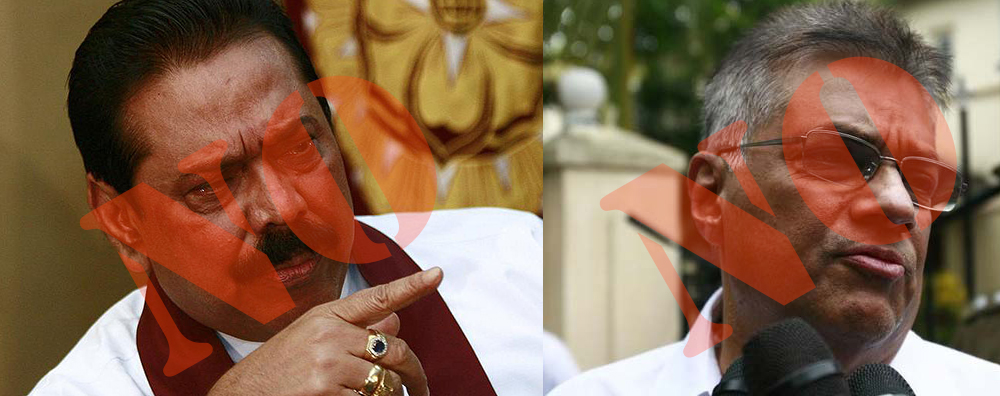
To the floating voter: You must make sure that you kick both Mahinda and Ranil out of politics

This is a brief missive by my friend Asoka Abeygunawardhane. 

High time that the voter ensures that these two geriatrics spawned by the corruption engines of the post 1977 era are sent out to pasture with as honorable an exit as possible

The Presidential Elections held on 8th January 2015 was a key political crossroad in the recent history of Sri Lanka. With the ascent of Maithripala Sirisena to the Presidency, the country breathed a collective sigh of relief. Many members of the losing party could hardly believe their eyes at the result. Now, seven months after that even, the General Election is upon us.

If by some miracle before the election…
  • Mahinda Rajapakse publically states that he would act within the Maitripala Presidency in the same manner as he did during Chandrika’s reign, or, if he publically states that he would act the same way D.M. Jayaratne acted during his tenure as president, then it would be opportune for you to vote for the UPFA.
  • If Ranil Wickremesinghe acknowledges the leadership of Maithripala Sirisena, steps down and hands over the leadership of the UNP to the president, then, it would be opportune for you to vote for the UNP.
  • If the JVP publically states that it will not sit with the opposition and decide to join a national government, then, it would be opportune for you to vote for the JVP.
  • If none of the above seem likely, then, preserve your valuable vote by not using it. Do not go to the polling booth. Or else, spoil go there and spoil it. 


However, none of these have happened.

The first thing that should be clear is that the country’s need is not of ranil Wickremesinghe’s “Aluth Ratak” nor Mahinda Rajapakse’s “Anaagathayata Sahathikaya” nor Anura Kumara Dissanayake’s “Hardhasakshiye Sammuthiya” but rather, Maithripala Sirisena’s “A compassionate maithri governance – a stable country”.

One the one hand, Ranil Wickremesinghe made it eminently clear on the 7th of last month that he was not interested in building “A compassionate maithri governance – a stable country”. In short, he is not at all interested in making Maithripala Sirisena his leader. All that the UNP wants to do is to make use of him to further their own ends. Their primary goal is to sell Maithripala Siresena in order to win the elections. They wish to then completely ignore and marginalize him and work as they wish to. Therefore, one of the paramount desires of the undecided voter should be to prevent Ranil Wickremesinghe from becoming the prime minister.

On the other hand, who would have thought that the defeated ex-president Mahinda Rajapakse would be contesting the general elections so soon? That is not something that could have occurred in the normal course of events. However, it happened. So, can we hope that he will now deign to work in the shadow of Maithripala Sirisena as his chief disciple? That is farfetched to say the least. Therefore, there is a justifiable fear in the minds of the undecided voter with respect to Mahinda Rajapakse being elected prime minister as well.

Surveys have shown that as things stand no one will get the 113 votes for a simple majority but that the UPFA will come out ahead.

Then, what would happen is the establishment of a national government with the UPFA and the UNP. Its’ prime minister would be a senior of the UPFA other than Mahinda Rajapakse. Whoever that individual is, he would be capable of being Maithripala’s right-hand-man over the next five years in the push for “A compassionate maithri governance – a stable country”. The next leader of the UNP would get a good start by acting as his left hand man.

Fortunately for us, Maithripala has shown us that he cannot be pushed around and has now single handedly taken on the task of governing the country.  As part of his advocacy efforts with Mahinda Rajapakse in the lead up to the elections, he sent a strong letter firmly stating that even if the UPFA obtains 113 seats he should not take the premiership.

  • Therefore, we should put our trust in Maithripala Sirisena and fearlessly vote for the Alliance.
  • If we are in some doubt about this, then we should assist Maithripala Sirisena by either refrain from voting or by spoiling our vote.


Thursday, July 16, 2015

Eurology 101 – Ridding a region of its toxins

A certain Mediterranean nation has taken up top-of-mind awareness of the planet these days with this brouhaha over 323 billion euros worth of indebtedness.  Dissecting the “what now?” is being quite well looked after with social, political and economic experts and analysts all weighing in with thoughts on outcome scenarios of what most now believe is one of the most poisonous deals ever made at one of the most crackbrained and insane economic summits of all time.

It is quite obvious by now that Greece is really not the problem but merely a symptom.  It is obvious that the perceived toxicity of Greece is hiding an underlying political-economic caustic that the Eurozone is either trying its best to dilute with rhetoric on rogue states or react with other equally corrosive elements such as um… bailouts cobbled together in a nuthouse to reach some sort of fission-neutral fiscal equilibrium.  

To figure out why, one must start with fundamental issues related to the difficulties that arise when the attempt at a common fiscal policy for Europe clashes with diverse fiscal traditions within its member states. Some are cavalier in their understanding of individual responsibility to pay taxes while others are straight laced orthodoxy in that department.  Some like to purchase expensive cars on lease without really caring too much about how they are going to pay their monthly installments. Some might want to borrow for infrastructure development whose ROIs are iffy and not well thought through. Whatever the differences, one thing is clear: Bad money management habits that are relatively small but spread across an entire nation’s psyche can do more harm to a country’s economic stability than a few big ticket errors. When Eurozone was created, everyone was looking at the big picture and no one really cared about these teeny tiny things but when a bunch of kids with wildly different ideas of fun and disparate types of sporting equipment try to play together in the same schoolyard, things can get pretty confusing, pretty ugly, pretty nasty - pretty fast.  


One must wonder what sort of lunacy prompted fairly rational human beings to rest the Eurozone on 17 struts that are unequal in size, strength, physical composition, angle of alignment and bearing capacity. Even a person with the intelligence of a nit would tell you that this is engineering insanity. Is it that surprising then that torques, tats and spats will abound? Is it that shocking that people will necessarily have to go 15 rounds on who is shouldering what burden, who is piggy-backing on whose efforts, what  is going to kick a prop out of kilter, who is going to repair the damage and, most importantly, if all of this is worth the few Euro more?

Well at the start, back in 1992, it seemed a jolly good idea to many Europeans. Europe united, if not under one flag, then under one currency. Money becoming less expensive, intra-union trade opportunities increasing, production increasing… the positives was both infinite and stratospheric. For a while, sure, euphoria generated the type of growth surge in member countries that would have been unimaginable before. This was before negativities related to cultural diversity, fiscal regularity, levels of productivity and national priority started to make themselves felt in the world of European economics and money markets. Suddenly, the playing field became uneven with production costs rising well beyond income from production increases for some European nations. Gradually, borrowings started to increase, productivity started to decrease, unemployment started to increase and some of the nations were staring down the barrel of a fiscal machine pistol.

One might think that the Eurozone, being under many flags would have anticipated this sort of thing and put in checks and balances to prevent it from becoming a reality and ensure that debt doesn’t spiral out of control.

They did.

That particular control instrument was called the Stability and Growth Pact (SGP) and it mandated that national debt should be no greater than 60% of GDP and a government deficit should be no greater than 3% annually. However, the two biggest economies of the Eurozone, France and Germany broke this pact in 2004 and instead of being punished for it, they rewrote the rules. Therefore, for six years starting from 2005, countries such as Greece no longer needed to follow the SGP. This, I call the first great crime of the Eurozone and it was not a sprat sized economy like Greece that was the culprit but its two largest. That politically unpunished, economically suicidal crime single handedly resulted in the misery that was later visited upon the Eurozone culminating in the 2015 summit debacle.

Greece didn’t cause this problem. It was collateral damage of what France and Germany did. The sharks blew it first and the minnows reaped the suffering.  By 2010, Greece was gasping for oxygen and Spain and Portugal were not that far behind. The Eurozone went into panic stations. They had to save their hides whatever the cost. Fearing a domino effect of the Grecian tragedy on other vulnerable members, they pumped the country full of Euros in 2010. That was one of the most selfish of all fiscal moves ever perpetrated by anyone ever. By doing what they did, they were not attempting to save Greece but the Euro and they fed the Greeks to the fiscal sharks to achieve it. The bailout was impossible to sustain and here is the clinch: Eurozone knew! They knew and they sacrificed one of their own family. To save what? Merely the idea of a family which was, even at its tightest, simply a loose network of distant relatives and their friends.

The insanity that is Greece in a nutshell. Schauble is right - Nobody knows. And that is a truly brilliant point to start getting a country back on track to physcal recovery a'la Eurozone. What a joke! 


No surprise that 2015 happened. No surprise that the new bailout package is the brainchild of viciously deranged human beings. This time around, the country that Eurozone was instrumental in mortally wounding back in 2010 is going to be murdered. The way? Cannibalize whatever is left that is of any worth in the country and deal with the human fall out in the same way that the world deals with a country like Chad or Somalia. Germany first and some of the others next mercilessly wish to treat one of their own in the same way they treat everyone else that they perceive as lesser than themselves despite of the fact that they were the direct cause of their downfall. They will treat them with supercilious, two-tongued, sanctimonious, self-righteous brutality. YUCK!

Italy knew this back in 2013. Mediobanca, Italy's second biggest bank in a humungous tome came close to calling for a withdrawal from the EMU and a return to the Lira. In that report, they indicated that Italy would be far better off outside EMU, and the implicit threat was that Italy will have to do so if the Northern creditor powers persist with their destructive regime.  The fact that their heads didn’t screw that easy was why they led a passionate defense of Greece at the meeting of lunes disguised as the Eurozone summit of July 2015.

Speaking about Italy in 2013, Ambrose Evans-Pritchard of the Telegraph says “Everything comes down to the national mood in the end. There was a time when the cause of Europe was unquestioned in Italy, but the long slump has taken its toll. An Ipsos poll this week found that a record 74pc of Italians are dissatisfied with the euro. It is a loveless marriage now. One more spat with Berlin and it will turn acrid”.

Well, that spat has already happened with Italian Prime Minister Matteo Renzi wading into Wolfgang German finance minister Schäuble during the Eurozone summit. If I were Eurozone, I would be thinking of what to do when, not if, Italy leaves. Such has been the conduct of its larger economies.


That conduct has been blasted by Nobel Economist Paul Krugman who said recently that the EMU demands are “madness” on every level.  “What we’ve learned these past couple of weeks is that being a member of the Eurozone means that the creditors can destroy your economy if you step out of line. This has no bearing at all on the underlying economics of austerity. This goes beyond harsh into pure vindictiveness, complete destruction of national sovereignty, and no hope of relief. It is, presumably, meant to be an offer Greece can’t accept; but even so, it’s a grotesque betrayal of everything the European project was supposed to stand for”.

Indeed.  At present, the Eurozone and its currency are its greatest poison. It’s greatest waste. Its most dangerous adversary.  If it is to remain at least reasonably credible in the eyes of the world, Europe must rid itself of them both and go on with life as it did before this disastrously failed experiment in common collectives.

If a relatively small economy such as Greece can cause this much trauma to a fiscal structure, then one must recognize that the structure is resting on a tiny cushion of very thin air. If it is to come to terms with its vulnerability, it should take a time out, take a reality check and get back on terra firma. At present, it still believes in its bullheaded madness that it can somehow weather this storm, bulldoze democracy with political thuggery and force a nation to renege on the outcome of its own referendum and accept the financial knife with which to commit national hara-kiri.  

A reality check won’t happen any time soon because Germany won’t want that. The Germans should be sweating pigs and peeing frogs but they are not. They can’t. As recent events show, they seem to have cauterized their toxin flushing organs in high handed blindness to facts. In their madness it seems as if they really don’t mind Europe going into collective renal failure or in this case, fiscal failure.

So, if things move in accordance with what stupidity can set in motion, this would be the third time in a hundred years that they have allowed their superiority complex to destroy Europe. This time would not be much different from the others. In their insanity, they will not only crash the rest of Europe but also pull their own house down upon their heads in the process. Tragic. 

A nation on its knees. Sovereignty lost. Riots on the streets. Democracy at its best at its birth place. Take a bow Eurozone. 

Monday, May 25, 2015

The state has withered away...

Here are a few things that should cost people nothing:

To be thrilled by someone else's gain, when they have terminally lost. 
To be thrilled by someone else's health, when they are terminally ill. 
To be thrilled by someone else's wealth, when they are terminally poor. 
To be thrilled by someone else's fame and praise, when they are terminally shamed and blamed. 
To be thrilled by someone else's pleasure, when they are terminally suffering.
To be thrilled by someone else's friends, when they are terminally alone. 
To be thrilled by that which someone achieves effortlessly, when they have had to battle to achieve even a microscopic part of it.  

This ecstasy only costs people their ego. Knowing the world for what it is, I suppose many people consider that loss not worth this joy. In heat, in hate, in horny hyper hopelessness, most have lost the ability to lose their egos. Holding onto it for dear life, they inherit from it, dear death. They must therefore rest in turmoil for peace is not theirs regardless of how much they speak about it, discuss it, analyze, infer it, deduce it, write about it, advocate for it, lobby for it or fight for it. Regardless of how they long for it. Regardless of how they crave it. Regardless of how they miss it. By choosing their right to ego, they have revoked their right to peace.  

In its stead, their ego buys them a mental living space of tumultuous spikes, sparks, dips and darks for they are thrilled by someone else's debilitation be that debilitation a loss, a disease, paucity, shame, blame, pain or mediocrity for it allow them to empathize and vindicates their relative non-weakness even though it is not tantamount to strength.

This perhaps, is why there is so little acknowledgement of infinite strength. Why so few are relieved by flawless decision making. Why naturally powerful personalities bring people out in spots.Why people  by default wish to crucify effortless leadership. Why universal respect for a person is called the adulation of the weak. Why unreflecting love is considered a value only by the weak where such weakness is there to be exploited.

Healthy, wealthy and wise people are blanked. They are treated much the same way as the missing parts of a leper or the lesions of an AIDS sufferer. With the same protest, the same revulsion, the same hope that if one ignores them long enough they will disappear from sight and mind and leave the normals, the mundanes, the muggles to mumble and bumble their way through life, cheering the story telling of Dheepan at Cannes, exploring the doubt of a game of thrones, shocking up the horror of a dead Robin a'la William. Protesting, encouraging and arguing over that war tactic, this climate change, that money market, this food shortage, that political manipulation, this resource exploitation.

The have-it-alls without wanting it all are to be reviled. Wiped off the face of the earth if possible. Their very presence is an invalidation of the premise that nothing is worth having if it didn't have to be paid for in blood, sweat, tears, battle, anger, jealousy or some other negative human effort or emotion.

So, armed with this dynamic, people joust with others engaged in the same game and call the resultant clashes, clouds, cacophonies and confusions...um...life? Giving and taking the short lived thrills and spills of a twilight flit and lilt between living and dying similar to the circuit breaking that occurs between dream states, wake states and sleep states in the REM phases of the night and calling it um... fulfillment?

Oh my god in heaven.

Small wonder the world is full of people for whom the human state has withered away for they have chosen, actively, to betray it at every turn while earnestly professing to uphold its highest ideal. 

Wednesday, April 8, 2015

Stepping on each other’s toes: Calhoun revisited

I feel like having me a whale of a time story telling. Indulge me folks.

As a teen, when we were scaring each other with horror stories, I used to be fond of telling the tale of over-crowded mouse enclosures where everything was aplenty but space at a premium. For me, it was the scientific bogey story to beat all bogey stories. Alas, my friends didn't seem to think so. They didn't remain my friends for much longer either. You see, there were no ghosts or zombies or aliens in my story and I was merely a morbid, pessimistic, storm crow.  When asked where I had heard the story, I carelessly said I had read it somewhere but couldn't remember. Their conclusion was obvious. I was a serious case of “nutjob”. I was to be left well alone, or, if touching was required, then, carefully, clad in a virus resistant coverall, with a ten foot long barge pole with a condom on it.  And, in Sri Lanka, in days when the number of humans was not that big and there was no internet for instant affirmation, my claims that rats and humans were interchangeable in the social ordering of exploding populations were deemed the stuff of a very seriously sickened imagination. 

 The story (for it does read that way) was one of the most famous social experiments of all time. It was designed and conducted by Dr. John B. Calhoun, the American ethologist and behavioral researcher and became famously known as the “behavioral sink”.  He started his work in 1947 and published his findings in the Scientific American in 1962. His paper became known as one of the 40 studies that changed psychology and went on to be quoted upward of a 150 times a year.

Here is a summary: 

Calhoun with his rodents
In 1947, John B. Calhoun built a quarter acre rat pen, or, what he called a “rat city,” which he seeded with five pregnant females. He calculated that the habitat was sufficient to accommodate as many as 5000 rats. Instead, the population levelled off at 150, and throughout the two years Calhoun kept watch, never exceeded 200. That the predicated maximum was never reached ought to come as no surprise: 5000 rats would be tight indeed. A quarter acre is little over 1000 square meters, meaning each rat would have to itself an area of only about 2000 square centimeters, roughly the size of an individual laboratory cage. Be that as it may, a population of only 150 seemed surprisingly low. What had happened?

He repeated the experiment in in 1954 at the Laboratory of Psychology of the National Institute of Mental Health where his “rodent universes” were populated using a variety of strains of rats and mice that were provided with food, bedding, and shelter. With no predators and with exposure to disease kept at a minimum, Calhoun described his experimental universe as “rat utopia,” or “mouse paradise.” With all their visible needs met, the animals bred rapidly. The only restriction Calhoun imposed on his population was of space – and as the population grew, this became increasingly problematic. As the pens heaved with animals, one of his assistants described rodent “utopia” as having become “hell” (Marsden 1972).

The first 100 days, Calhoun described as the "strive phase" where nests were built and territories marked. In the next 250 days, the population exploded, doubling every 60 days. This was described by Calhoun as the "exploitation phase". As the population increased, most associated eating and drinking with  - and in - the presence of others. Yet, use of resources became unequal although each living area was identical in structure and opportunity.


However, in the next period consisting of about 300 days, Calhoun found the population levelled off in what he called the “equilibrium phase”. He noticed that new generations of young were inhibited since most spaces were already socially defined. Unusual behavior was noticed. Violence became prevalent. Dominant males became aggressive, some moving in groups, attacking females and the young. Mating behaviors were disrupted. Excess males tried for acceptance and were rejected, withdrew and fought among themselves. Some became exclusively homosexual. Others became pansexual and hypersexual, attempting to mount any rat they encountered. The effects of violence became increasingly visible with some individuals targeted for repeated attacks. Other young growing into adults showed an even stranger behavior at this stage with new generations devoting themselves to grooming, eating and sleeping. They never engaged with others, nor did they fight nor did they have sex. Calhoun called them the beautiful ones. They were wonderful specimen of the species, with keen eyes and healthy, well- kept bodies. These however, were unable to cope with external stimuli and although they seemed alert and inquisitive they were in fact very stupid. 

Calhoun calls the last phase the "die phase" leading the population to extinction.  Mothers neglected their infants, first failing to construct proper nests, and then carelessly abandoning and even attacking their pups. In certain sections of the pens, infant mortality rose as high as 96%, the dead cannibalized by adults. Subordinate animals withdrew psychologically, surviving in a physical sense but at an immense psychological cost. They were the majority in the later part of the “die phase”, existing as a vacant, huddled mass in the center of the pens. In the shift from the equilibrium phase to the die phase, each animal became less aware of its associates despite all the animals being pushed closer together. Calhoun thought this was because the animals could not deal with repeated contact with many others. Unable to breed, the population plummeted and did not recover. The crowded rodents had lost the ability to co-exist harmoniously, even after the population numbers once again fell to low levels. At a certain density, they had ceased to act like rats and mice, and the change was permanent.

Like Pavlov’s dogs or Skinner’s pigeons, Calhoun’s rats came to assume a near-iconic status as emblematic animals, exemplary of the ways in which behavioral experimentation at once marks and violates the human-animal distinction. The macabre spectacle of crowded psychopathological rats and the available comparisons with human life in the densely-packed inner cities ensured the experiments were quickly adopted as scientific evidence of social decay (Ramsden and Adams (2009)).

Arrite! ‘nuff science. 

The parallels to modern human behavioral trends are quite obvious. While I have sufficient metaphysical evidence to be anthropocentric, in this case, I stand down on that stance. No one needs metaphysics or density studies to figure this one out.

The reason why each of us needs more space than our physical bodies inhabit is because of something zoologists call the “flight distance” (The minimal distance from another animal or human at which point it decides to flee). Beyond that point, any encroachment of space, or, "minimal point of territorial integrity", moves the animal closer to “fight distance” at which point the animal decides that it cannot flee but can only fight. 

With 7,125,000,000 people, 148,326,000 sq.km of total land mass and 29,242,234 sq.km (just 19%) of habitable land mass, each of us has approximately 4,104 sq. meters to live on. Let us try to apply the rat-universe parallel of a maximum of 200 rats per 1000 sq.m to human habitation. Taking that 400 rat bodies would approximately fit in to a single human body, add an alpha factor of 3.0 - 4.0 for the larger brain and we have already two-fold exceeded our peak point population vis-à-vis overcrowding. Two fold! When one takes into account that not all habitable land is actually occupied, we have a very large number of people living in many high density pockets (metros, cities, towns etc.) where the flight-distance is already invaded and in many cases, even the fight-distance has been compromised. 49 wars at present across the planet folks. FORTY NINE I tells ya... 49! Most of them group driven, ethnoreligious, genocidal, brutally extravagant in the type and form of murder and the direct and indirect body count. You want an example of Human Calhoun rats in stage 4? 2 million people murdered of which 50000 were children in the so-called war on terror in Iraq. 
Too many rats... ahem... people! 

So, while continuing our commitment to excess and waste, while continuing our desire to fornicate like rabbits and breed like rats, can we resolve conflict? No. Can we curb roaming gangs of politicians and thugs attacking anything and everything? No. Can we curb galloping same-sex relationships? No. Can we curb this preoccupation with manicures, haute couture, haute cuisine, haute gyms and umbrellas? No. Can we curb the explosion of shrinks and couches? No.

Yeah, who is not fighting these days? Who is not competing? Who is not highly opinionated? Who is not self-centered? Who is not angry? Who is not complaining? Who is not jealous? Who is not wounded? Who is not scarred? Who doesn't have eating disorders? Who isn't spending inordinate amounts of time in the salon? Who doesn't need a shrink?

We are beyond striving, exploiting and equilibrium now. We are, truly, in the last phase. We have cast the die and the die reads "die". 

Well then, what on earth are we doing here, going round and round the mulberry bush like rats in a trap, trying this democracy or that dictatorship, this rule or that law? Not a lot that bears mentioning.

Instead, what we have are psychopathological humans huddled over mobile devices, running away from social engagement, slamming themselves repeatedly into waves of information explosions comparable only to population explosions, running screaming away from that into vacant staring or equally vacant copulation, terrified of committing to anything, scared witless of breeding and feeding and caring, rationalizing every irrational behavior, throwing kids at daycares, killing teachers, raping mothers, humping anything that moves, bouncing from twenty-minute uppers to twenty-day downers, desanitizing bodies with every kind of drug imaginable, searching…searching…searching… uselessly for an escape from this overpopulated prison we call earth. 
   
Next time you have the urge to FaceBook, NightClub, WhatsApp, DrugNight, ScrewBinge, TVDinner, ChatFeed, SpouseCheat, MathMull, StratPlan, CutSlack, GrowBeard, DyeHair, FaceLift know this: #YouCannotEscape. You are the #Doomsday. You are the #StormCrow. 

You are the chaos point. You are the morbidity metric. You are the nectromantic vacant.

You? ...are the hell.

(I was describing this experiment to Srilal Perera a fellow member of the Mind On Matters (MoM) group on facebook at a recent meet and Naren Bartlett, with half-an-ear on the conversation thought it would be good to post this on the group so I wrote it up in some detail. Thanks for the motivation Naren and Srilal!) 

Saturday, March 28, 2015

Review of “Revolution of the Era” by Asoka Abeygunarwardana

How David slew Goliath or how the opposition managed the impossible despite of itself


(The translator’s job is to translate. It is up to others to review a work but in this case, my role as translator and my role as an independent citizen of Sri Lanka got admixed. Here therefore, is the strange phenomenon of a translator actually reviewing his own work)


I have never voted in an election despite the fact that it was my right and my franchise to do so. I refrained because I was not entirely convinced of the truthfulness of modern representative democracy when the word Demokratia (demos / kratos) meaning “people’s power” and direct democracy said that any citizen of a nation or community or group who wished to engage it, could participate in government.

People in my country, in general, over the last seven or so decades have rarely if ever had a chance to participate. Their only claim to civic glory was “I voted for this or that government” or “I hate this or that government because I didn’t vote for it”. In each of the dozens of elections hidden behind a much touted, oft misunderstood, definitely popular democratic façade, the new government voted itself in, riding on the short term machinations of a few individuals keenly cognizant of an individual’s worth either as a brand (saleable) or as a commodity (essential). I do not vote because history has shown me that regardless of, despite of, because of, the people’s aspirations of heaven after a given election, the politic has failed people’s power and I am not sufficiently dumb to believe that the next election would be any different from those that preceded it.

Yet, the civic conscious citizenry of the country, whether they vote or not, primarily, keep their ears to the socio-politic, the political-economic and socio-environment baseline and secondarily, look for extraordinarily ordinary fellows (not as in the derogatory way that term is used in these days but rather in terms of brothers) who are smart enough, brave enough and committed enough to engage in demos-kratos for the social, political and environmental benefit of all. They are at best reviled or at worst snuffed. Such is the madness we call this country of ours.

On the 21st of December 2014, I met such a one. On Polhengoda road. I was buying groceries. His small office and my small home share the same lane so the meet wasn’t entirely happenstance. He rolled down his window and I said “සිරා game එකක් ගහනවා කියල අරන්ච්ච්යි.”. He said “මහින්දගේ කාලේ ඉවරයි” I said, “මෛත්‍රී ගන්න එක ලෙහෙසිත් නැහැ, රනිල් ඉල්ලන එක නවත්තන්න ලෙහෙසිත් නැහැ. කොහොමද වැඩේ කෙරුවේ?”  He gave me an enigmatic smile.

That man was Asoka Abeygunarwardana, the key political strategist in the multiplayer, multipart drama that brought down the supposedly invincible incumbent President Mahinda Rajapakse. In his recently published book “Yuga Peraliya” translated into English as “The Revolution of the Era” he gives us an electric commentary of the punch-by-counter punch political chess game that should keep people staring sightless, hours after the last page is read, shaking their head in wonder at how something this far-fetched could actually happen.


With a powerful incumbent with near total control of the political machinery of a country drowning in corruption, a fractured and weakened opposition and the citizenry resigned to “more of the same” subsequent to a “sure-thing” Mahinda victory, this world-shocking transition could only have happened if the key moves were made by someone with great civic aspirations and no political ones.

Asoka seems to have fit the bill to the T and as one reads through the incidents, one starts to understand the self-promotional rationale of politicians regardless of the country and becomes increasingly aware that only a relatively neutral but highly civic conscious person could have managed to engineer the enabling conditions for an opposition victory. In the immediate aftermath of the opposition victory, there were many claims made by many people as to how important their role was in bringing about the envisaged change but one realizes as one reads through the book that those claims are highly questionable. Asoka sums this up with a cliché that is nevertheless true in these circumstances “Victory has many fathers but defeat is an orphan”.

He is at his abrasive and honest best in his portrayal of the battle of our times and he makes no excuse for it. Having known him for a decade and having much respect for similar honesty on the part of his father before him, this came as no surprise at all. In a heady narrative, Asoka takes us back to January 27th 2013 and the determining factor that turned the worm as it were and started the campaign and how Mahinda, riding upon a bucking, over confident bronco, charged forward on a journey towards self-destruction. Describing the aftermath of that decision, he takes us through the launch and public acknowledgement of the Pivithuru Hetak Movement (PHM) and, the simple but brilliant political strategy engineered by Asoka and Shiral Lakthilaka to bring the two nationalist forces under Ven. Ratana and Rev. Maduluwawe Sobhitha who headed up the National Movement for a Just Society (NMJS) together towards the launch of the proposal for the 19th Amendment to the constitution. He states the high regard he has for Rev. Ratana and how he single handedly wrested control of the nationalist forces from the insanity of the Bodu Bala Sena and how he managed to engineer an alliance between Sinhalese and Tamil nationalists towards a common goal.  Reading like a political thriller, the story takes the reader through the political sharpness of Ranil Wickremesinghe, the role of Patali Champika Ranawaka, the betrayal of Udaya Gammanpila, the tragedy of Dayaasiri, the madness of Tissa Attanayake, the doubt of Nimal Siripala, the actions of minority parties, the astigmatism of the JVP. It barrels the reader through a campaign never started, a campaign undone, a campaign floundering, a campaign resurrected literally from the ashes. From the reason why 300 days were cut to 100 days, through manifesto before marketing, past මෛත්‍රී පාලනයක් vs Unite for Change, money vs no money, cutouts vs no cutouts, the book unravels intrigue upon intrigue, outlines failed strategies giving rise to innovative thrusts and pulls, storms before the calm and loud calls of confrontation, manipulation, confusion, conviction and sacrifice as the variously positioned pieces of this nationwide chess game move inexorably towards checkmating the king.

The incumbent used every undemocratic practice to prevent the opposition message from getting across to the people and yet, that very strategy backfired on a campaign blinded by a totalitarian ideology and an insatiable ego.   

Three facts emerge from this book that cannot be contested. The first is that Maithripala Sirisena, in one of the bravest and most selfless moves in modern politics anywhere in the world, walked out of the SLFP and literally off the political ledge, with only a fleeting glimpse of vague political possibilities as his surety and thereby created by default, the force behind which an opposition could fall in line despite the fact that it was at sixes and sevens with itself. The second is the debunking of the claim that the opposition victory was due to the minority vote. The third is that the floating vote that was created by the Jathika Hela Urumaya (JHU) in 2004 gestated, matured and ripened over a decade and became the key block that swung the election in favor of Maithripala Sirisena.

Hanging over all of these political pyrotechnics, Asoka points out this significant determinant: The people were sick of Mahinda, sick of his high handed ways, sick of the misery he was unleashing on everyone through his henchmen, sick of the opposition and its weak, goalless meandering and desperately searching for a political personality that had been largely unscathed and unsullied by personal desire or personal gain and they found that person in Maithripala Sirisena and voted for him.
 
Yet, despite of all of that, Asoka points out that this is still a work-in-progress and that initial mistakes in the immediate aftermath of the victory have resulted in relative chaos with respect to the executive and the mandate given to parliament and whether or not that mandate is valid. Such is, when one sees the selfless collide with the selfish.

As Bobby Fisher said “Every checkmate is a stalemate at another level” and as my friend, intellectual critic and fellow debater Kumi Nesiah says “The reason why nations use Democracy as the state religion is not because it prevents revolutions through higher satisfaction but because it channels the energies of dissatisfaction into false revolutions called elections. Like any state religion, it's just another façade”. I am not able to contest those assertions either as a master chess player then nor a civic conscious a-political thinker now.

Still, all is not lost. As long as there are people like Asoka who understands the egos and manipulations of the many and the strategy to create democratic spaces that had been severely compromised in the recent past, others who hid themselves in civil society action for the people when the rulers had reneged on that promise are now capable of involving themselves directly in government through demos-kratos.

The hidden message of “Revolution of the era” is that selfless individuals can single handedly make massive changes happen if they are malleable, are not inclined to cleave to views, are willed to know truthfully not blindly, are brave enough to experience directly, are capable of stating the start of such inquiry impartially, are capable of holding its conclusion until the completion of such inquiry, are capable of stating the results of such a conclusion impartially and finally, and most importantly, are capable of understanding that the best compromise is one that makes nobody happy.


Revolution of the Era - Asoka Abeygunawardana (Please feel free to download this but if you are a kindle user, please help Asoka cover his costs by getting the kindle version from amazon.com) 

Monday, March 16, 2015

Language... matters

Here’s a story Albert Einstein was fond of telling:
“I was at a tea in Princeton. The hostess asked me to explain relativity theory in a few words”.
So I said, “I once had a friend who was blind from birth and one day we went for a hike in the country. It was hot so after a couple of hours we sat down to rest”.
“How thirsty am I” I remarked to my friend, “I wish I had a cool glass of milk”.
“What is milk?” my friend inquired.
“Milk? Milk is a white fluid”.  
“I know what fluid is” my friend responded but what is “white?”
“White is the color of the swan’s feathers”
“I know what feathers are but what is a swan?”
“A swan is a large bird with a crooked neck”
“I can understand that” my blind friend replied, “Except for one thing. What is crooked?”
“Here” I said seizing his arm and stretching it out. “Now your arm is straight”. Then I folded it against his chest “And now your arm is crooked”.
“Ah, now I know what milk is.”

This is a story not of the foolishness of a blind man but rather, the gulf that separates individual cosmologies from each other and the essential uselessness of attempting to explain one of them with the tools available to the other. Einstein was capable of recognizing that and that is what I like about him the most. He was not the world’s greatest mind nor was he the world’s greatest scientist – those assertions are highly debatable except to those to whom Einstein is the equivalent of Jesus. Well marketed ideas mind you but like all marketing, to be taken with very large mountains of salt. No, what I like about him is the fact that he played the violin and considered that a greater achievement than his work in theoretical physics.

Here then is another “tea-party story” in similar vein although in this, instead of two disparate entities talking irreconcilable languages, this one is about a common language and its importance to everyone. It is a personal testimony of journalist Jerome Weidman. There are many versions of this story but this is the one I like best:

“When I was a very young man, just beginning to make my way I was invited to a talk by a great scientist at one of the more upmarket addresses in the Princeton area. The ride was difficult, it was raining, and I ran in breathless and very late. The hostess, slightly harried, says that the talk is over but they had retired to the drawing room so could I please fix myself a drink and get my late-ass in there without delay?”

It was an enormous room and the other guests were coming in in twos and threes and my eyes beheld two unnerving sights: Servants were arranging small gilt chairs in long, neat rows; and up front, leaning against the wall, were musical instruments.

Apparently I was in for an evening of chamber music.

 I use the phrase “in for” because music meant nothing to me. I am almost tone deaf—only with great effort can I carry the simplest tune, and serious music was to me no more than an arrangement of noises. So I did what I always did when trapped: I sat down, and when the music started, I fixed my face in what I hoped was an expression of intelligent appreciation, closed my ears from the inside, and submerged myself in my own completely irrelevant thoughts.

After a while, becoming aware that the people around me were applauding, I concluded it was safe to unplug my ears. At once I heard a gentle but surprisingly penetrating voice on my right: “You are fond of Bach?”

I knew as much about Bach as I know about nuclear fission. But the old man who was sitting there next to me was irksome and had decided to compound my misery it seems.

“Well,” I said uncomfortably and hesitated. I had been asked a casual question. All I had to do was be equally casual in my reply. But I could see from the look in my neighbor’s eyes that their owner was not merely going through the perfunctory duties of elementary politeness. Regardless of what value I placed on my part in the verbal exchange, to this man his part in it mattered very much. Above all, I could feel that this was a man to whom you did not tell a lie, however small.

“I don’t know anything about Bach,” I said awkwardly. “I’ve never heard any of his music.”

A look of perplexed astonishment washed across his countenance.

“You have never heard Bach?”

He made it sound as though I had said I’d never taken a bath.

“It isn’t that I don’t want to like Bach,” I replied hastily. “It’s just that I’m tone deaf, or almost tone deaf, and I’ve never really heard anybody’s music.”

A look of concern came into the old man’s face. “Please,” he said abruptly. “You will come with me?”

He stood up and took my arm. I stood up. As he led me across that crowded room, I kept my glance fixed on the carpet. A rising murmur of puzzled speculation followed us out into the hall but the man seemed not to notice.

Resolutely, he led me upstairs. He obviously knew the house well. On the floor above, he opened the door into a book-lined study, drew me in, and shut the door.

“Now,” he said with a small, troubled smile. “You will tell me, please, how long you have felt this way about music?”

“All my life,” I said, feeling awful. “I wish you would go back downstairs Sir. The fact that I don’t enjoy it doesn’t mean I deprive you of it.”

He scowled “You can go through life knowing nothing of mathematics or physics or science. They are not all that important to life or enjoyment. However, you cannot possibly go through life without music so, tell me if there is any kind of music you like?”

“Well,” I answered, “I like songs that have words, and the kind of music where I can follow the tune.”

He smiled and nodded, obviously pleased. “You can give me an example, perhaps?”

“Well,” I ventured, “almost anything by Bing Crosby.”

He nodded again, briskly. “Good!”

He went to a corner of the room, opened a phonograph, and started pulling out records. I watched him uneasily. At last, he beamed. “Ah!” he said.

He put the record on, and in a moment, the study was filled with the relaxed, lilting strains of Bing Crosby’s “When the Blue of the Night Meets the Gold of the Day.” He beamed at me and kept time with the stem of his pipe. After three or four phrases, he stopped the phonograph.

“Now,” he said. “Will you tell me, please, what you have just heard?”

The simplest answer seemed to be to sing the lines. I did just that, trying desperately to stay in tune and keep my voice from cracking. The expression on the old man’s face was like the sunrise.

“You see!” he cried with delight when I finished. “You do have an ear!”

I mumbled something about this being one of my favorite songs, something I had heard hundreds of times so that it didn’t really prove anything.

“Nonsense!” says he. “It proves everything! Do you remember your first arithmetic lesson in school? Suppose, at your very first contact with numbers, your teacher had ordered you to work out a problem in, say, long division or fractions. Could you have done so?”

“No, of course not.”

“Precisely!” he made a triumphant wave of his hand. “It would have been impossible, and you would have reacted in panic. You would have closed your mind to long division and fractions. As a result, because of that one small mistake by your teacher, it is possible your whole life you would be denied the beauty of long division and fractions.”

The hand went up and out in another wave.

“But on your first day, no teacher would be so foolish. He would start you with elementary things—then, when you had acquired skill with the simplest problems, he would lead you up to long division and to fractions.

“So it is with music.” He picked up the Bing Crosby record. “This simple, charming little song is like simple addition or subtraction. You have mastered it. Now we go on to something more complicated.”

He found another record and set it going. The golden voice of John McCormack singing “The Trumpeter” filled the room. After a few lines, he stopped the record.

“So!” he said. “You will sing that back to me, please?”

I did—with a good deal of self-consciousness but with, for me, a surprising degree of accuracy.

He stared at me with a look on his face that I had seen only once before in my life: on the face of my father as he listened to me deliver the valedictory address at my high school graduation ceremony.
“Excellent!” he remarked when I finished. “Wonderful! Now this!”

“This” turned out to be Caruso in what was to me a completely unrecognizable fragment from Cavalleria Rusticana, a one-act opera. Nevertheless, I managed to reproduce an approximation of the sounds the famous tenor had made. The old man beamed his approval.

Caruso was followed by at least a dozen others. I could not shake my feeling of awe over the way this great man, into whose company I had been thrown by chance, was completely preoccupied by what we were doing, as though I were his sole concern.

We came at last to recordings of music without words, which I was instructed to reproduce by humming. When I reached for a high note, his mouth opened, and his head went back as if to help me attain what seemed unattainable. Evidently I came close enough, for he suddenly turned off the phonograph.

“Now, young man,” he said, putting his arm through mine. “We are ready for Bach!”

As we returned to our seats in the drawing room, the players were tuning up for a new selection. he smiled and gave me a reassuring pat on the knee.

“Just allow yourself to listen,” he whispered. “That is all.”

It wasn’t really all, of course. Without the effort he had just poured out for a total stranger I would never have heard, as I did that night for the first time in my life, Bach’s “Sheep May Safely Graze.” I have heard it many times since. I don’t think I shall ever tire of it. Because I never listen to it alone. I am sitting beside a small, round man with a shock of untidy white hair, a dead pipe clamped between his teeth, and eyes that contain in their extraordinary warmth all the wonder of the world.

When the concert was finished, I added my genuine applause to that of the others.

I was still in my own dreamworlds when the hostess came up to me sighing “Oh it was a wonderful talk you missed” but I hardly heard her. The music was in my ears and I was staring across the room at the old man who was talking to the other guests. I pointed him out to the hostess and asked “who is that man?”

“Why you chump” she cries out. “That’s the man who gave the talk. That’s Albert Einstein”.


For those of you who want to know...